
Ropewalks: Long and Low
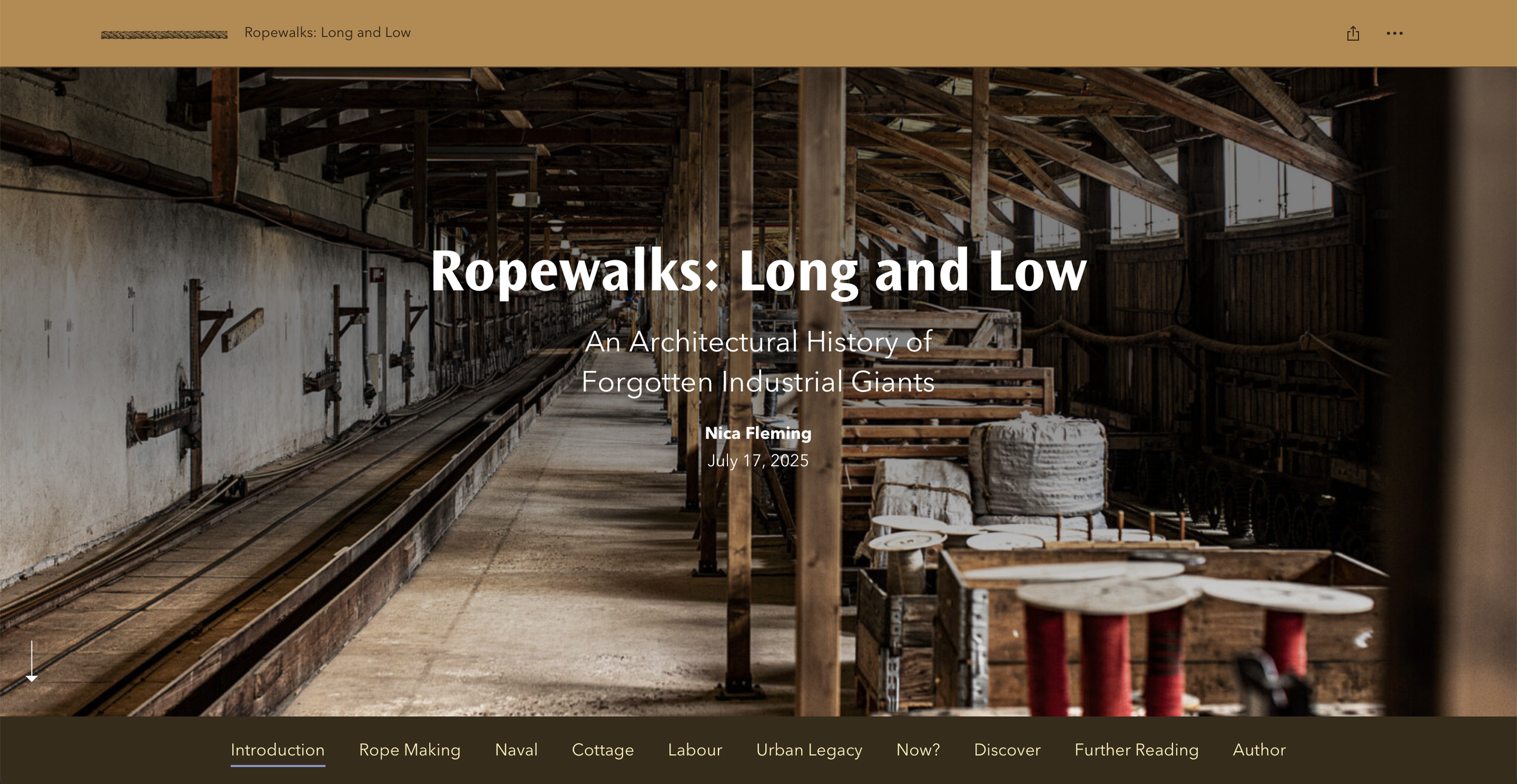
Landing page of the digital humanities mapping project Ropewalks: Long and Low
Introduction
In that building, long and low,
With its windows all a-row,
Like the port-holes of a hulk,
Human spiders spin and spin,
Backward down their threads so thin
Dropping, each a hempen bulk.
- Henry Wadsworth Longfellow, "The Ropewalk," 1858
Henry Wadsworth Longfellow's 1858 poem " The Ropewalk " describes a building unlike one many of us have ever seen. "Long and low" and with lined-up windows, he compares this hulking structure to a beached ship. Although difficult for us to picture today, these buildings were once ubiquitous in every city due to their crucial function as factories for a perennially necessary material: rope.
Rope touched countless aspects of civilization and was consistently produced in huge quantities, and as a result, the spaces where rope was made came to quietly define historical cities. Or, maybe not so quietly, since those spaces had to be undivided straight lines stretching hundreds of meters in length. Those spaces were ropewalks.
The goal of our project is to find and compile ropewalks to better understand them as a building type, but also to introduce people to these unique structures. What were ropewalks, and why were they "long and low?" If they were so common, why have so few people heard of them? And how can we see their influence in cities today?
Continue to read about and explore the ropewalk mapping project at the link below!
